
Individualized Education Programs (IEPs) are designed to support students with disabilities by creating tailored educational plans that meet their unique needs. Within these plans, terms like “benchmarks” and “objectives” are often used interchangeably, but they serve distinct purposes. Understanding the difference between IEP benchmarks and IEP objectives is crucial for educators, parents, and support staff to ensure meaningful progress for students.
In this blog post, we will break down what benchmarks and objectives are, how they differ, and how each plays a critical role in a student’s IEP.
Grab this free IEP parent input form for IEP benchmarks and IEP objectives – great to get ideas!
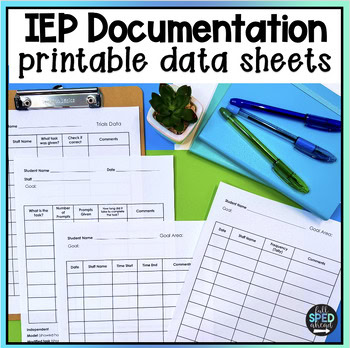
IEP objectives are measurable, specific, and smaller criteria that outline the steps a student needs to take to achieve their broader measurable annual goals. These objectives are often broken down into smaller, manageable tasks to track incremental progress. They provide a roadmap for teachers and support staff to guide the student’s learning throughout the year.
Key Features of IEP Objectives:
For example, if the annual goal is for a student to write a complete paragraph independently, an objective might be:
Objective A: “The student will write a sentence with correct punctuation 4 out of 5 opportunities.”
Objective B: “The student will write a sentence with correct grammar 4 out of 5 opportunities.”
Objective C: “The student will write a sentence with correct spelling 4 out of 5 opportunities.”
All 3 objectives would be worked on simultaneously over the IEP year.
IEP benchmarks, on the other hand, are used to outline major milestones within the broader annual goal. Benchmarks are less about the incremental steps and more about making significant progress throughout the year. These are typically used to provide a clear picture of how the student is advancing toward their annual goals in a measurable way.
For example, if the annual goal is for a student to read at a second-grade level by the end of the year, a benchmark might be:
“By the end of January, the student will read a first-grade reading passage with 60% accuracy.”
“By the end of March, the student will read a first-grade reading passage with 70% accuracy.”
“By the end of May, the student will read a first-grade reading passage with 80% accuracy.“
Goal – “By the end of the IEP year, the student will read a first-grade reading passage with 90% accuracy.”
While both IEP benchmarks and IEP objectives serve to guide a student’s progress, their primary differences lie in their scope and purpose:
| Aspect | IEP Objectives | IEP Benchmarks |
|---|---|---|
| Purpose | Break down annual goals into smaller, actionable steps. | Mark significant progress points toward annual goals. |
| Scope | Short-term, focused on specific skills or tasks to achieve the goal. | Broader, milestone-based progress markers. |
| Timeline | Throughout the IEP year. | Quarters or semester reporting |
| Common Use | When they need to gain a variety of skills to get to an overarching skill EX: Increase ability to answer mathematical equations Obj A: addition Obj B: subtraction Obj C: multiplication Obj D: division | When they need to make gains in ONE skills over a longer period of time. EX: Increase ability to answer addition questions Benchmark A: 60% accuracy Benchmark B: 70% accuracy Benchmark C: 80% accuracy Goal: 90% accuracy |
IEP benchmarks and IEP objectives are critical components of a well-rounded special education plan. While they serve different purposes, both work together to ensure students make meaningful progress toward their annual goals. By understanding the differences and using each effectively, educators can create IEP goals with IEP benchmarks and IEP objectives that truly meet the needs of their students.
If you’re looking for tools to streamline your IEP writing process, check out our specialized resources designed to help you create clear and actionable goals for your students.
To read more:
IEP Goal Tracking: Meaningful Strategies for Special Education Teachers
A Strong Collaborative IEP Meeting in 3 Steps
Effective Behavior and IEP Data Collection in Special Education
